
Business
Alphabet Takes Aim at Nvidia as AI Market Shifts

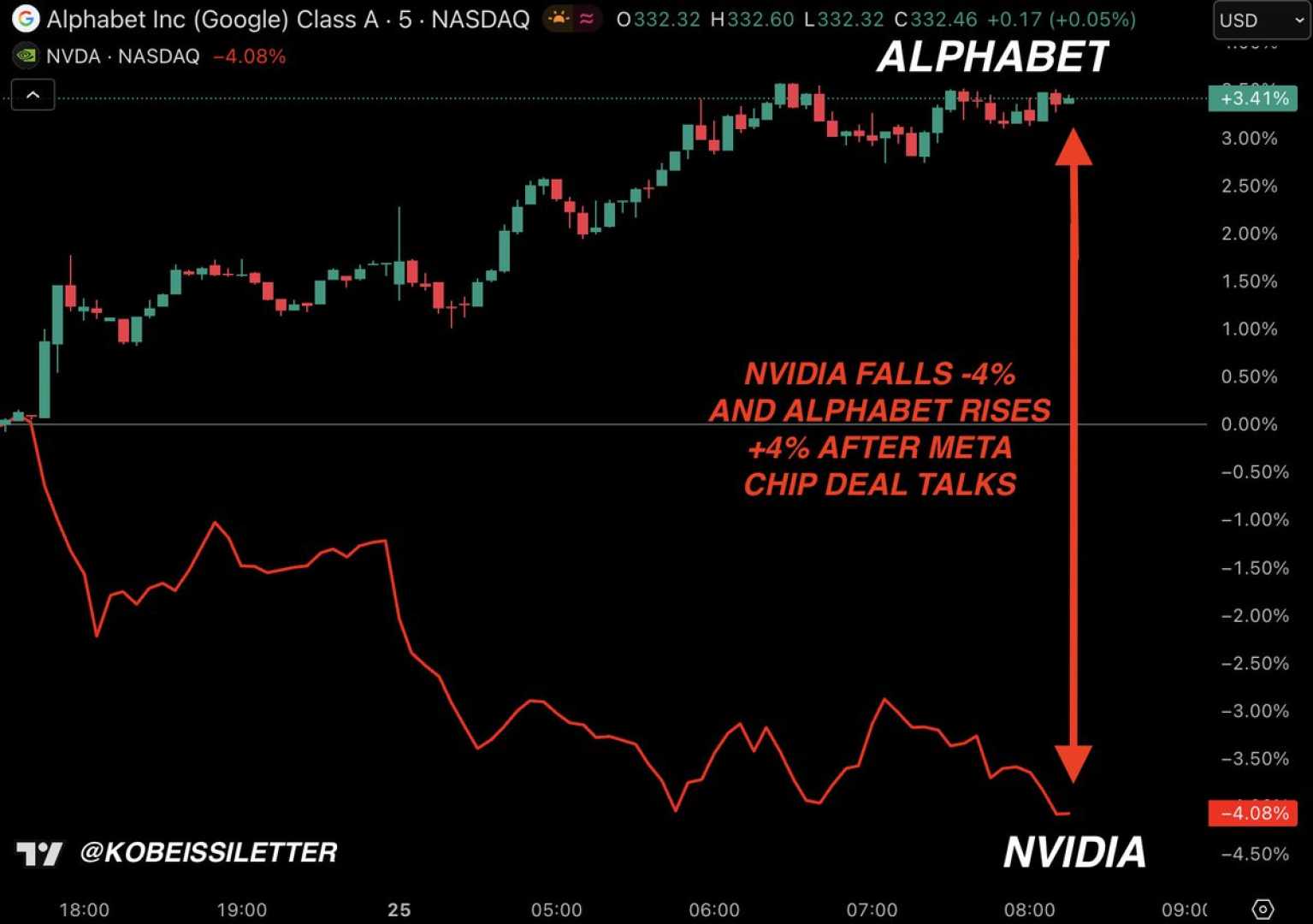
San Francisco, CA — The artificial intelligence market is undergoing significant changes as Alphabet challenges Nvidia‘s long-standing dominance. For the past two years, investors primarily bought stocks tied to generative AI, with Nvidia seen as the dominant player. Recent shifts signal a maturation of the market, now placing pressure on Nvidia as Alphabet closes in on a $4 trillion market valuation.
This change comes as Alphabet’s efforts in custom silicon are starting to generate revenue, evidenced by a more than 15% rise in its stock this month. In contrast, Nvidia has seen its shares drop approximately 12%, driven by increasing concerns over its sustainability in a market where major buyers are also becoming suppliers.
Industry insiders view Meta Platforms‘ negotiations to purchase billions of dollars worth of Google‘s AI chips as a turning point. Google, which historically kept its Tensor Processing Units (TPUs) within its ecosystem, is now opening its chip technology to competitors, challenging Nvidia’s hardware offerings directly.
This potential collaboration with Meta suggests a future where Google’s custom chips could handle specific tasks more effectively than traditional Nvidia GPUs. As Dan Morgan, a senior portfolio manager at Synovus Trust, pointed out, Google has significant resources to compete, unlike smaller enterprises that have tried to chip away at Nvidia’s market share.
Meanwhile, Nvidia is facing scrutiny over its financial practices. Michael Burry, known for exposing financial irregularities during the 2008 crisis, has taken a bearish position against the chipmaker, drawing parallels between Nvidia’s situation and the excesses seen during the dot-com bubble. His criticism adds to growing concerns over possible “circular financing” within the AI ecosystem.
In response, Nvidia circulated a defensive memo to analysts, attempting to reassure investors of its financial integrity. But some analysts believe this response may have backfired, making the company appear rattled. Gil Luria of D.A. Davidson noted that lengthy defenses could signal weaknesses.
Meanwhile, optimism outside the Nvidia realm is growing, as sectors like retail and healthcare perform well. Analysts at Hovnanian Family Office believe that a focus on price stability from the incoming administration could positively affect equity markets.
Even with these shifts, the consumer spending outlook remains uncertain, as reports indicate that fewer consumers plan to increase their holiday shopping this year. This uncertainty highlights the importance of ROI for large-scale AI investments moving forward.
The landscape of Big Tech is changing rapidly, not only due to potential collaborations but also because of Alphabet’s success with its new Gemini 3 model and its ability to adapt to regulatory challenges. Alphabet is now perceived as a force in AI, through its control over its data, models, and increasingly, its silicon manufacturing.
As the AI market matures, investing strategies are shifting from a broad focus on companies associated with AI to evaluating their vertical integration and efficiency. Nvidia must now prove that its market position is not threatened by new entrants like Google and Meta. If Meta chooses Google’s custom chips for its data centers, it could redefine industry standards, potentially limiting Nvidia’s growth.


