
News
Comet 3I/ATLAS Reaches Perihelion, Drawing Global Astronomical Interest

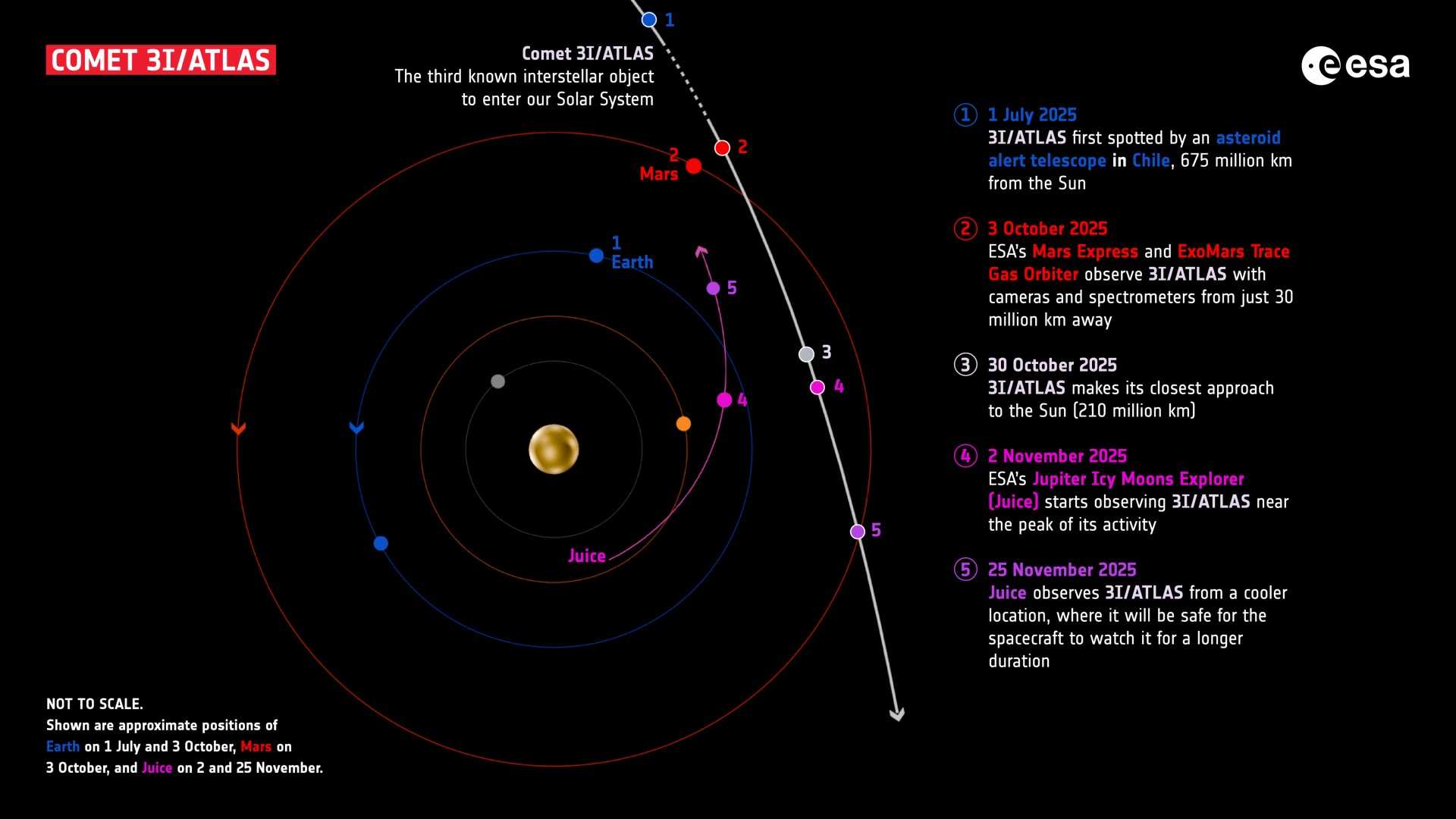
CAMBRIDGE, Mass. — Comet 3I/ATLAS reached its closest point to the Sun on October 30, 2025, exciting astronomers worldwide. This interstellar comet, the third confirmed of its kind, has traveled billions of miles from another star system before entering ours.
Discovered in July 2025 by the Asteroid Terrestrial-impact Last Alert System (ATLAS), 3I/ATLAS is categorized as an interstellar object due to its hyperbolic trajectory, which allows it to pass through the solar system without being pulled back by the Sun’s gravitational force.
At its perihelion, the comet is expected to be approximately 130 million miles from the Sun. As it nears this point, scientists aim to study its composition and behavior as it interacts with solar radiation. Observations indicate a solid, icy nucleus measuring between 1,000 feet and 3.5 miles in diameter.
David Jewitt, science team leader for the Hubble Space Telescope observations, remarked, “No one knows where the comet came from. It’s like glimpsing a rifle bullet for a thousandth of a second.” Experts believe that 3I/ATLAS is likely billions of years old, having formed under conditions much different from those of our solar system.
Research teams are eager to analyze data from multiple space missions, including Hubble and other observatories, which are tracking the comet’s activity as it approaches the Sun. As of now, Comet 3I/ATLAS is too close to the Sun to be visible but is anticipated to become observable by mid-November.
In addition to its importance to astronomy, 3I/ATLAS has drawn speculation about extraterrestrial origins. Avi Loeb, head of the Galileo Project at Harvard University, suggested the comet might have unusual characteristics indicating possible advanced technology. However, many experts maintain that it behaves like a typical comet.
Tom Statler, a lead scientist at NASA, stated, “It looks like a comet. It does comet things. The evidence is overwhelmingly pointing to this object being a natural body.”
As 3I/ATLAS continues its journey out of the solar system after its perihelion, it will reach its closest point to Earth on December 19, 2025. The public and amateur astronomers will soon have the chance to observe this rare interstellar visitor.


