
News
ESA Improves Comet 3I/ATLAS Trajectory Using Mars Orbiter Data

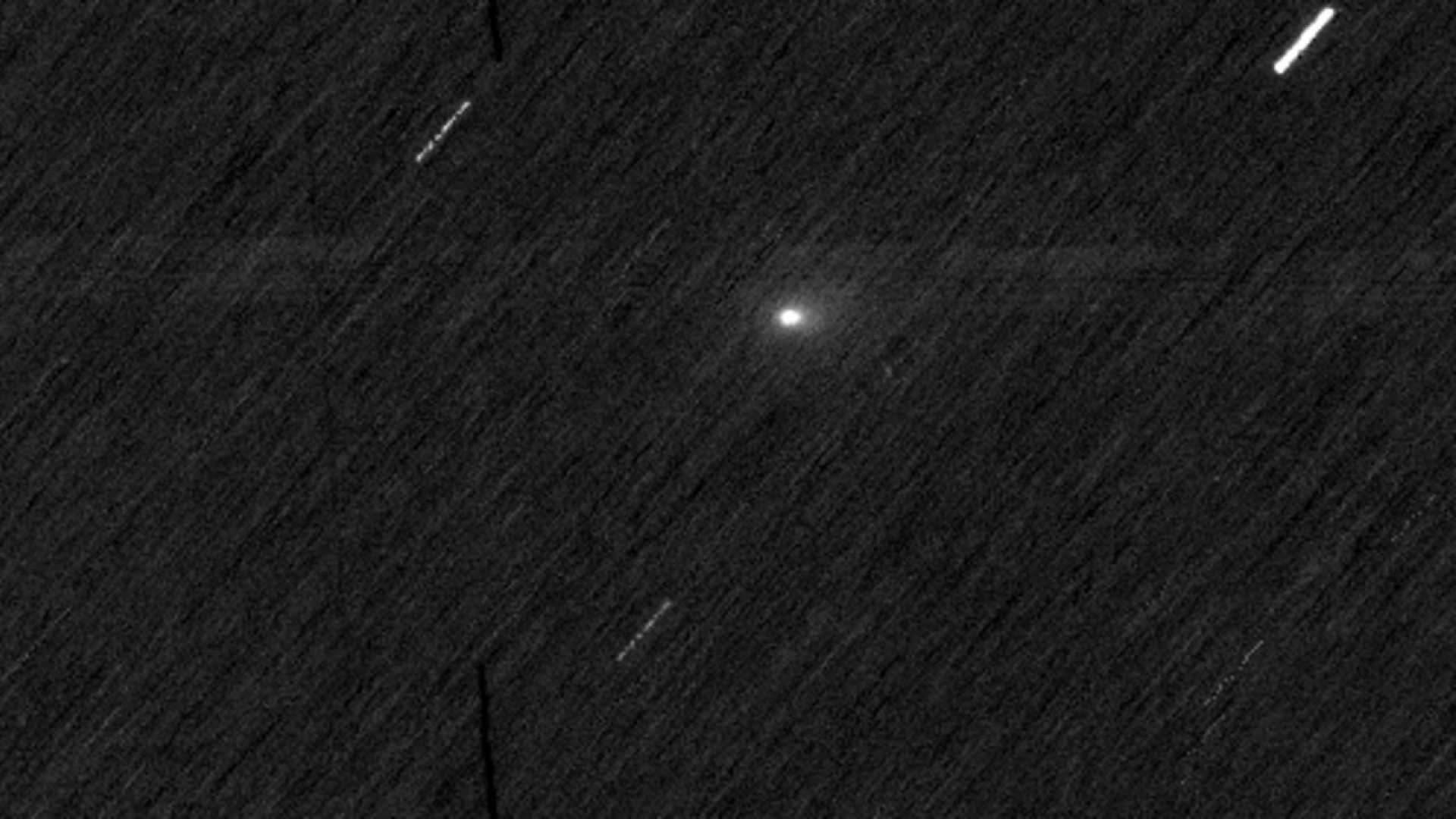
ESA, Noordwijk, Netherlands — ESA scientists announced on November 16, 2025, that they have significantly improved the trajectory predictions for the interstellar comet 3I/ATLAS, discovered on July 1, 2025. Thanks to data from the Trace Gas Orbiter (TGO) spacecraft operating around Mars, the comet’s predicted location has been enhanced by a factor of ten.
This innovative use of Mars-based observations allowed scientists to better track the comet’s passage through the Solar System, providing a unique opportunity for planetary defense analysis despite 3I/ATLAS posing no threat to Earth.
Prior to October, the trajectory predictions relied heavily on Earth-based telescopes. However, from October 1 to October 7, the TGO successfully observed 3I/ATLAS as it came within approximately 29 million kilometers of Mars during its closest approach on October 3.
The TGO’s camera, typically focused on the Martian surface, was redirected to capture the distant comet against the backdrop of stars. This adjustment allowed the spacecraft to obtain data that was ten times closer than what Earth telescopes could capture.
The scientists, who specialize in asteroids and comets, faced challenges due to the spacecraft’s specific location at Mars, unlike typical observations made from fixed positions on Earth. They collaborated across different teams at ESA to refine the comet’s ephemeris precisely.
The updated trajectory predictions result from a combination of data from both Earth and Mars observations, marking the first time such measurements have been formally accepted into the Minor Planet Center (MPC) database. This development enhances the monitoring capabilities for near-Earth objects.
Even though the findings do not suggest 3I/ATLAS is a threat, ESA considers this exercise valuable for planetary defense practices. Routine monitoring is conducted to calculate the orbits of potential hazards, demonstrating the importance of using multiple viewpoints to gather data.
The TGO will continue to observe 3I/ATLAS until it rapidly exits the Solar System, traveling at speeds up to 250,000 kilometers per hour.
As part of ongoing research, 3I/ATLAS will also be monitored by the Jupiter Icy Moons Explorer (JUICE) once the comet moves past the Sun. Data from these observations are anticipated in February 2026.


