
Tech
Google’s Quantum Breakthrough Could Transform Computing Landscape

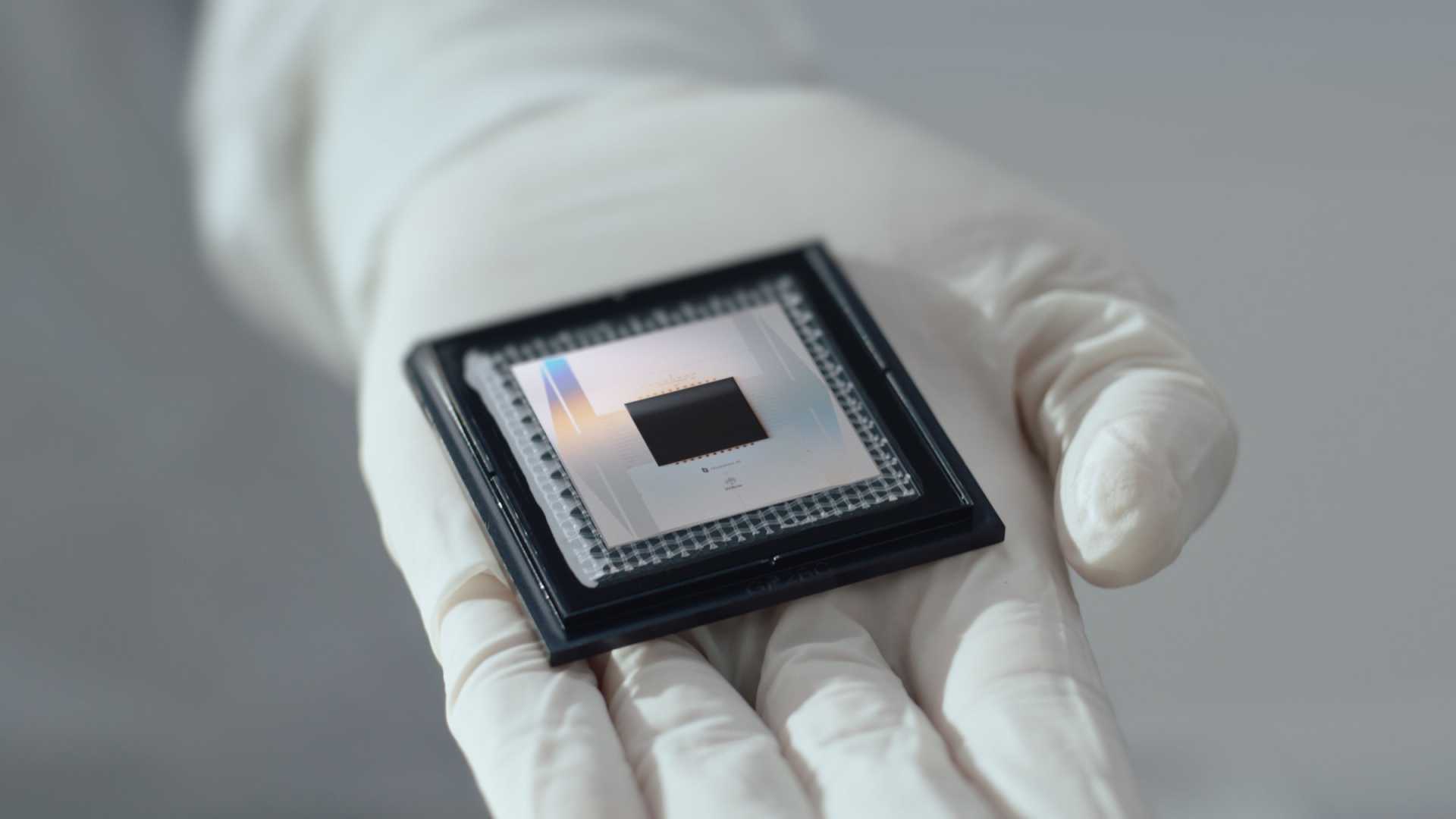
MOUNTAIN VIEW, Calif. — Google Quantum AI has reported a groundbreaking experiment that propels quantum computing into what researchers describe as the “beyond-classical” realm. This achievement demonstrates the capabilities of Google’s 65-qubit superconducting processor and could pave the way for practical applications in various fields within five years.
In a study published in the journal Nature, researchers outlined an experiment involving the second-order out-of-time-order correlator, or OTOC(2). The calculation that would take approximately 3.2 years on the Frontier supercomputer, the leading classical machine, was completed in just over two hours on Google’s quantum device, reflecting an impressive speedup of about 13,000 times.
Hartmut Neven, Vice President of Engineering at Google, emphasized the significance of this milestone at a press conference, stating, “To summarize sort of the key features that make Quantum Echoes an algorithmic breakthrough is first, quantum advantage.” He explained how the algorithm produces verifiable predictions, which can be confirmed through different quantum computers or direct experimental verification.
The experiment investigates how information propagates and interferes within complex quantum systems. In these chaotic environments, known as “ergodic” regimes, classical computers struggle due to the exponential growth of parameters associated with qubits. The team used a protocol technique that enables time reversal, allowing them to “rewind” quantum evolution and capture interference patterns that would otherwise be lost.
Tom O'Brien, a staff research scientist at Google, described the innovative aspect of the Quantum Echoes algorithm: “The key innovation […] is that we evolve a system forward and backward in time.” The results reveal highly sensitive connections in a quantum system, allowing the team to observe how quantum information interacts and transforms amidst chaos.
The results from the experiments on a 65 superconducting qubit lattice showed that the team could measure complex interference patterns, which classical modeling could not efficiently reproduce. This capability suggests significant advancements toward practical quantum advantage, where quantum computers can provide insights that classical systems cannot.
The study also delved into Hamiltonian learning — extracting unknown elements of quantum systems. This proof-of-principle indicates that quantum processors could be utilized as diagnostic tools in real-world applications by correlating experimental data with quantum simulations.
Google Chief Scientist Michel Devoret pointed out that the algorithm’s ability to link experimental NMR data to quantum models could reveal structural details hidden from classical approaches. He stated, “This could be applied even to quantum sensing,” underscoring the potential for a symbiotic relationship between quantum computing and sensing technologies.
While the algorithm’s current application remains limited, the findings signal progress in the development of quantum computing, particularly in areas such as materials science and drug design. The team aims to push the boundaries of quantum technology further, combining improved algorithms with hardware advancements.
As the researchers concluded, Google’s roadmap for quantum development looks optimistic, projecting that within five years, real-world applications unique to quantum computing will emerge. The advances signify a notable shift in computing capabilities, with Google leading the charge into an innovative era.


